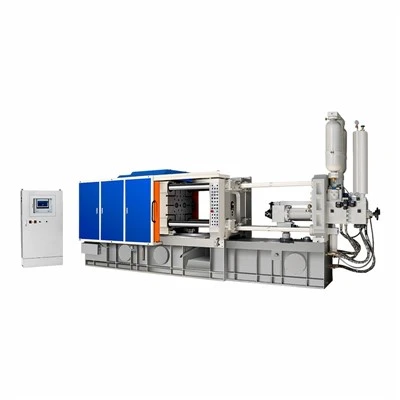
If you’ve ever stood in a die casting facility, watching molten aluminum flow smoothly into a precision mold before solidifying into a sharp, durable component, you’ve probably wondered: what’s the exact melting point of aluminum for die casting? It’s not a random number we pull from a textbook—this is a critical detail that directly impacts die casting quality, machine performance, and even production costs. As a die casting machine supplier, I get asked this question at least a dozen times a week, usually from new customers just getting their feet wet with aluminum die casting, or from seasoned operators troubleshooting why a batch of parts has porosity or incomplete fill. Let me break this down, cut through the confusion, and explain how this number ties to every part of the die casting process. Die Casting Machine
First, let’s start with the basics: pure aluminum’s melting point. Most of us learned in high school chemistry that pure aluminum (99.9% Al) melts at 660.32°C (1220.58°F). That’s the textbook number, the baseline. But here’s the thing: almost no one uses pure aluminum for die casting. Why? Pure aluminum is soft, prone to excessive oxidation, and doesn’t have the structural strength most industrial parts require (think automotive engine components, plumbing fittings, or consumer electronics housings—all die cast from aluminum alloys). Die casting aluminum relies on specialized alloys, and alloying elements change the melting point dramatically.
That’s the first common misconception I help customers work through. I once had a customer who bought a used die casting machine and set his furnace temperature to exactly 660°C, only to get parts that never fully filled the mold. He was using an A380 alloy—one of the most common aluminum die casting alloys—and A380’s melting range isn’t 660°C. It’s a range, not a single number. For A380, the solidus temperature (the point where the alloy starts to melt, i.e., when it’s no longer fully solid) is around 571°C (1060°F), and the liquidus temperature (the point where it’s fully molten and flowable) is around 607°C (1125°F). So to get fully flowable aluminum for die casting, you have to heat it above that liquidus point—usually between 650°C and 700°C (1200°F to 1292°F). That’s why his 660°C furnace was too low: his alloy wasn’t fully molten, so it thickened mid-flow and left incomplete parts.
Let’s talk about why alloys have different melting ranges. When you add elements like silicon, copper, magnesium, or zinc to pure aluminum, you create a mixture where the atoms disrupt the regular crystal structure of pure metal. This lowers the melting point and creates a gap between when the alloy starts to melt and when it’s fully liquid—this is called the melting interval, and it’s non-negotiable for die casting. Die casting requires molten metal that is thin enough to flow at high speed into tiny, intricate mold cavities, but not so thin that it burns, oxidizes, or loses too much heat before solidifying. Each die casting aluminum alloy is formulated to strike that balance.
Take A356, another super common alloy used for structural parts like engine brackets and wheels. A356 has a higher silicon content than A380, which makes it more fluid when molten. Its liquidus temperature is around 615°C (1139°F), so typical working temperature is 660°C to 710°C (1220°F to 1310°F). Compare that to Alloy 413, used for high-volume, complex parts, whose liquidus is around 575°C (1067°F), so you often work at 640°C to 680°C. Even small differences in alloy composition change this: a batch of A380 with a tiny bit more copper will have a slightly lower liquidus than a batch with less copper. That’s why we always advise customers to check the specific data sheet for their exact alloy, not just a generic aluminum melting point number.
Now, why does this matter for die casting, not just metallurgy? Let’s walk through the process step by step, and how melting temperature ties into every stage. First, melting and holding the aluminum. If you heat your alloy too far above its liquidus, you run into problems: excessive oxidation. Molten aluminum reacts with oxygen in the air to form aluminum oxide, a hard, gritty compound that gets trapped in the die casting, causing defects like surface blemishes, porosity, or weak spots. Too much heat also speeds up wear on your furnace crucible and die casting machine components—especially the plunger and shot sleeve, which are in constant contact with hot metal. I’ve seen customers push a machine to 750°C to “make sure the metal is liquid” only to replace their shot sleeve six months early, a cost that could have been avoided with a 50°C temperature adjustment.
On the flip side, if you don’t heat it high enough, you get what my customer faced earlier: incomplete die fill, cold shuts (where two streams of metal meet and don’t fuse), and part inconsistency. Part solidification time is also tied to melting temperature. If your metal is just barely molten, it will solidify faster once it hits the cool die, which can lead to thin walls not filling. If it’s too hot, it takes longer to solidify, increasing cycle time—cycle time directly ties to your production output. A die casting machine that runs 10 cycles per minute vs. 12 is a huge difference for high-volume parts like phone cases, where you need thousands of units a day. That extra heat also means more energy use, so operating at the right melting temperature saves on utility costs too.
Another factor specific to die casting is the type of die casting you’re doing. High-pressure die casting (HPDC) is the most common for aluminum, and it requires molten metal that’s ready to flow at extreme speed—often 1 to 5 meters per second into the mold. For HPDC, you typically target temperatures 30°C to 50°C above the alloy’s liquidus. For low-pressure die casting, which is used for larger, thicker parts, you can run slightly lower temperatures, since the metal flows more slowly and has more time to fill the mold without cooling too fast. Even gravity die casting has its own sweet spot, usually 50°C to 70°C above liquidus. We work with customers to adjust temperature based on their process because not all die casting is the same.
I also get asked a lot about temperature measurement accuracy. A cheap thermocouple that’s off by 20°C can ruin a whole batch of parts. I recommend investing in calibrated, industrial-grade temperature sensors that are placed directly in the molten metal, not just on the furnace wall. The wall temperature might be 650°C, but the actual metal could be 630°C, which is too low. This is a common mistake for new operators who don’t realize that furnace walls cool over time, or that adding solid aluminum ingots temporarily lowers the metal temperature. You have to adjust the temperature every time you add a new batch of ingots, too—adding cold ingots pulls heat out of the molten metal, so you might need to raise the furnace temperature by 10°C to compensate for 200 kg of new metal.
Let’s talk about a recent example from a customer of mine that drives home why this is so important. A small automotive parts shop was running A380 alloy for brake caliper housings, a high-stakes part that can’t have any internal porosity. They were using a generic melting point number of 660°C, so they set their machine to that, and for a while, parts looked good. But when demand spiked, they ran their furnace at max to keep up, and started getting a 15% reject rate due to hidden porosity. They called me, and we tested their metal temperature with a direct immersion sensor—turns out their metal was only 645°C, well below A380’s liquidus of 607°C, so it was partially solid when it hit the mold. We adjusted the temperature to 665°C, right above liquidus, and their reject rate dropped to under 1% within a week. That’s the real impact of getting this right: not just better parts, but higher profits from less waste.
What about aluminum alloys used in specialty die casting, like for aerospace or medical parts? Those often have even stricter temperature requirements, since they’re formulated for high strength and corrosion resistance. For example, the aluminum-lithium alloys used in aerospace die casting have melting points around 600°C to 620°C, so you have to heat them to 640°C to 680°C, but you have to be extra careful not to overheat them because they’re more prone to oxidation. Medical-grade aluminum alloys, used for surgical instruments or implant components, need pure, defect-free metal, so temperature control is even tighter—within 10°C of the liquidus, to avoid both incompletely molten metal and excessive oxidation.
Now, as a die casting machine supplier, what do we do to help our customers get this right? We don’t just sell you a machine and walk away. We provide process guides tailored to the alloys you plan to use, with exact temperature ranges, and we work with you to set up your temperature measurement and control systems. Many of our newer die casting machines come with integrated temperature sensors that feed real-time data to the machine’s control panel, so you can monitor and adjust temperature automatically, reducing human error. We also offer training sessions for new operators, specifically covering melting points, alloy-specific temperature needs, and how to avoid common mistakes like overheating or underheating metal.
Wait, let’s circle back to that original question again: what is the melting point of aluminum for die casting? The short answer is: it depends. It depends on the alloy you’re using, the type of die casting process, the size and complexity of your parts, and even your production speed. There’s no single number, and anyone who tells you there is is either oversimplifying or doesn’t understand the nuances of aluminum die casting. The key is to know your alloy’s solidus and liquidus temperatures, then set your working temperature 20°C to 70°C above the liquidus, adjusted for your specific process and equipment.
I’ve been in this industry for 12 years, and I’ve seen so many shops struggle with this at some point. One shop even tried to use a wood furnace to melt aluminum for die casting, thinking it would work, because they read that aluminum melts at 660°C and assumed any heat above that would do it. That’s a recipe for disaster—wood fires are uneven, and you can’t get consistent temperature, leading to garbage parts and a broken furnace. The right equipment, paired with the right temperature knowledge, is everything.
Another common myth: adding scrap aluminum to the melt doesn’t change the melting point. Not true. Scrap aluminum can have small amounts of other metals from previous uses, so even a tiny trace of lead or tin can lower the melting point of the alloy. If you’re using 100% new ingots, you can stick to the alloy’s data sheet, but if you’re mixing in scrap, you’ll need to test the alloy’s composition regularly and adjust your temperature accordingly. We recommend using a small alloy analyzer on-site for shops that use a lot of scrap, so you can get real-time data on what you’re melting and adjust temperatures as needed.
At the end of the day, aluminum’s melting point for die casting is a foundational detail that separates a good production run from a bad one, and a profitable shop from one that’s throwing away money on rejected parts. It’s not just a metallurgy fact—it’s a core part of your process, your equipment setup, and your bottom line. If you’re new to die casting, or if you’re struggling with part defects or cycle time, don’t overlook this. It’s one of the simplest adjustments that can make the biggest difference.

If you’re ready to upgrade your die casting equipment, or if you want to troubleshoot temperature-related issues in your current process, we’re here to help. We work with shops of all sizes, from small family-owned operations to large automotive manufacturers, to provide tailored solutions that get the melting temperature right, every time. Whether you need a new die casting machine, process training, or support optimizing your current setup, we’re ready to connect. All you have to do is reach out to start the conversation.
Z-type Kneader References
- ASM International. Aluminum Alloys for Die Casting: Properties and Processing. ASM Handbook, Volume 15: Casting, 2008.
- Die Casting Development Council. Die Casting Alloy Data Sheets: Aluminum Alloys. DCDC Technical Publication No. 4, 2021.
- Campbell, J. Complete Casting Handbook: Metal Casting Processes, Metallurgy, Design and Design. 2nd Edition, Butterworth-Heinemann, 2015.
- American Foundry Society. Temperature Control for Aluminum Die Casting: Best Practices. AFS Die Casting Technical Guide, 2019.
Nantong Hengming Machinary Co., Ltd.
Address: B201, Rugao E-Commerce Industrial Park, No.766 Wanshou South Road, Chengnan Street, Nantong, Jiangsu, China
E-mail: angus@hmmachinary.com
WebSite: https://www.hmmachineries.com/
